
Date: OCT 2026
India’s equity markets have had a difficult year, with Nifty 50 trading nearly 14% below its all time high. The weakness extends beyond the recent correction, with the index still down 7.3% over two years and 12.4% over the past year. For investors who entered the market two years ago, the experience has been frustrating, with little progress to show for their patience. Yet, investor participation remains strong. Equity mutual funds attracted ₹38,307 crore in September, while monthly SIP contributions touched a record ₹32,490 crore. This contrast highlights a familiar challenge in equity investing. While investors are willing to participate when markets are rising, falling prices and prolonged stagnation can make fresh investments harder to commit to. History, however, suggests that returns rarely arrive in a steady progression. Understanding how these returns unfold offers valuable insight into the opportunities that investors may overlook during uncertain periods.
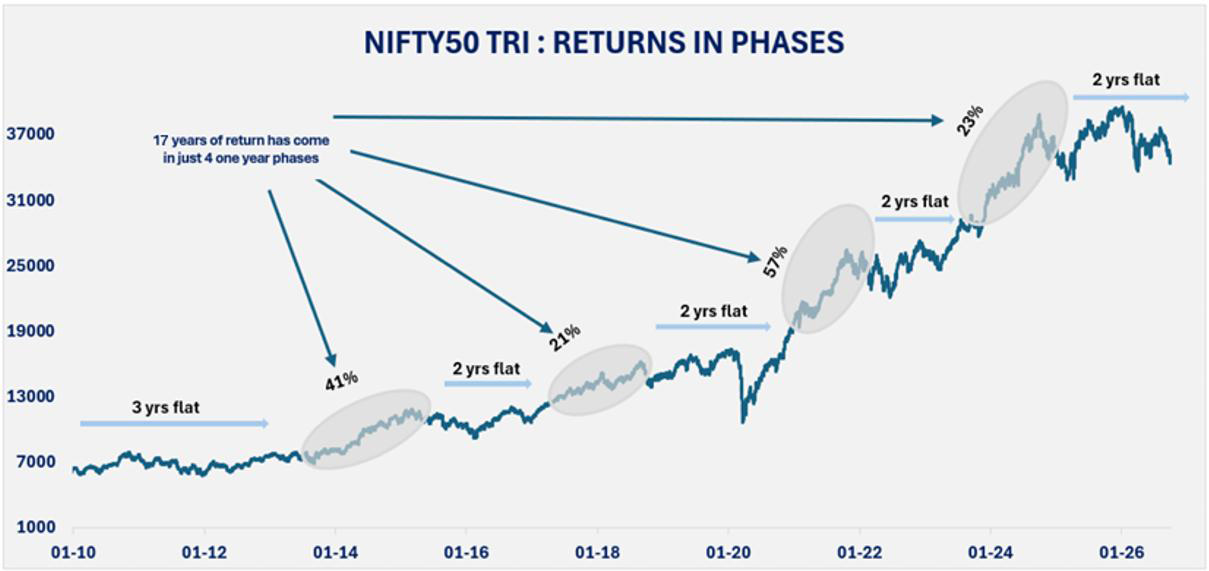
Nifty 50 Total Return Index (TRI) illustrates how unevenly equity returns can accrue. Its history includes several phases of consolidation lasting two to three years, during which the index made little headway despite the passage of time. Such periods can test investor patience, particularly when portfolios show limited growth despite remaining invested. Yet, these stretches tell only part of the story. A closer examination of the index reveals that a handful of exceptional periods have contributed disproportionately to its overall gains.
Source: NSE Indices (Data as of 21st October 2026)
A striking feature of Nifty 50’s historical performance is that four one-year periods delivered returns of 41%, 21%, 57% and 23%. Outside these phases, the index spent considerable time moving sideways, offering limited reward to investors waiting for their portfolios to grow. This is the opportunity paradox. When markets rally, confidence often rises and investors become more willing to commit capital. When markets correct or remain stagnant, uncertainty tends to take centre stage, making investors hesitant even when valuations have become more reasonable. Those who wait for conditions to feel comfortable again may find that markets have already recovered a significant part of their lost ground. The challenge is not simply identifying opportunities but having the conviction to act when they appear least appealing.
The current correction brings this challenge into focus. As highlighted in our Monthly Market Outlook for October, Nifty 50 valuations have fallen below their long-term average, while India’s growth and earnings outlook remains resilient. The near-term direction will depend on factors including crude oil prices, global bond yields and monetary policy developments. Although these uncertainties warrant attention, waiting for a definitive market bottom can mean missing opportunities along the way.
Periods of stagnation and market weakness often test investor conviction, making it tempting to wait for conditions to improve before committing fresh capital. Yet, by the time confidence returns, markets may have already recovered much of their lost ground. In our view, this is a phase to build equity exposure gradually rather than wait for a definitive market bottom. A staggered approach allows investors to take advantage of more reasonable valuations without having to predict the market’s next move. Over time, the ability to stay invested through market uncertainty and participate in periods of recovery can make a meaningful difference to investment outcomes.
DISCLAIMER: This report/presentation is intended for the personal and private use of the recipient and is for private circulation only. It is not to be published, reproduced, distributed, or disclosed, whether wholly or in part, to any other person or entity without prior written consent. The report/presentation has been prepared by Privus Advisors (Firm) based on the information available in public domain & other external sources which are beyond Privus’ control and may also include the Firm’s personal views. Though the recipient recognizes such information to be generally reliable, the recipient acknowledges that inaccuracies may occur & that the Firm does not warrant the accuracy or suitability of the information. Neither does the information nor any opinion expressed constitute a legal opinion or an offer, or an invitation to make an offer, to buy or sell any financial or other products / services or securities or any kind of derivatives related to such securities. Any information contained herein relating to taxation is based on the information available in the public domain that may be subject to change. Investors/Clients should refer to relevant foreign exchange regulations / taxation / financial advice as applicable in India and/or abroad about the appropriateness and relevance / impact of the views or suggestions expressed herein, related to any Investment/Estate Planning / Succession Planning. All investments are subject to market risks, read all related documents carefully before investing. The Firm is registered with SEBI as a non-individual RIA bearing Reg. No. INA000019752 & BSEASL membership No. 2230. Registration granted by SEBI, membership of BASL and certification of National Institute of Securities Markets (NISM) in no way guarantees performance of the intermediary or provide any assurance of returns to investors.